
How to Become a Data Center Technician With No Experience
How to Become a Data Center Technician With No Experience
The short answer to how to become a data center technician with no experience is to build basic hardware and networking skills, earn CompTIA A+ as your first certification, practise on real hardware at home, and apply through the doors that actually hire beginners: paid trainee programs, contract and staffing roles, colocation smart hands jobs, and help desk work that leads into a data center. A four-year degree is not required. A recent Amazon posting for a Data Center Technician asks for a high school diploma or equivalent, and Microsoft lists the same minimum. The honest catch is that many direct-hire postings also ask for about a year of hardware troubleshooting or related IT experience, so the plan below is built around getting that year of proof another way. If you are ready to look at live openings, the latest roles are listed on JobCada.
This guide is the follow-up to our overview of What Jobs Are Inside a Data Center? Roles, Pay and How to Get In. That post lists every role inside a data center, what it pays, and the full 30-day entry plan. This post goes one level deeper on a single role and a single starting point: you, with no experience, becoming a data center technician. It covers what the job really involves, the exact requirements in real postings, which lane to pick, the skills to build, the certifications in the right order, the free training programs, the entry points that hire beginners, a full sample CV, the interview questions they always ask, a week-by-week 90-day plan, and what your first 90 days on the job actually look like.
What a Data Center Technician Actually Does All Day
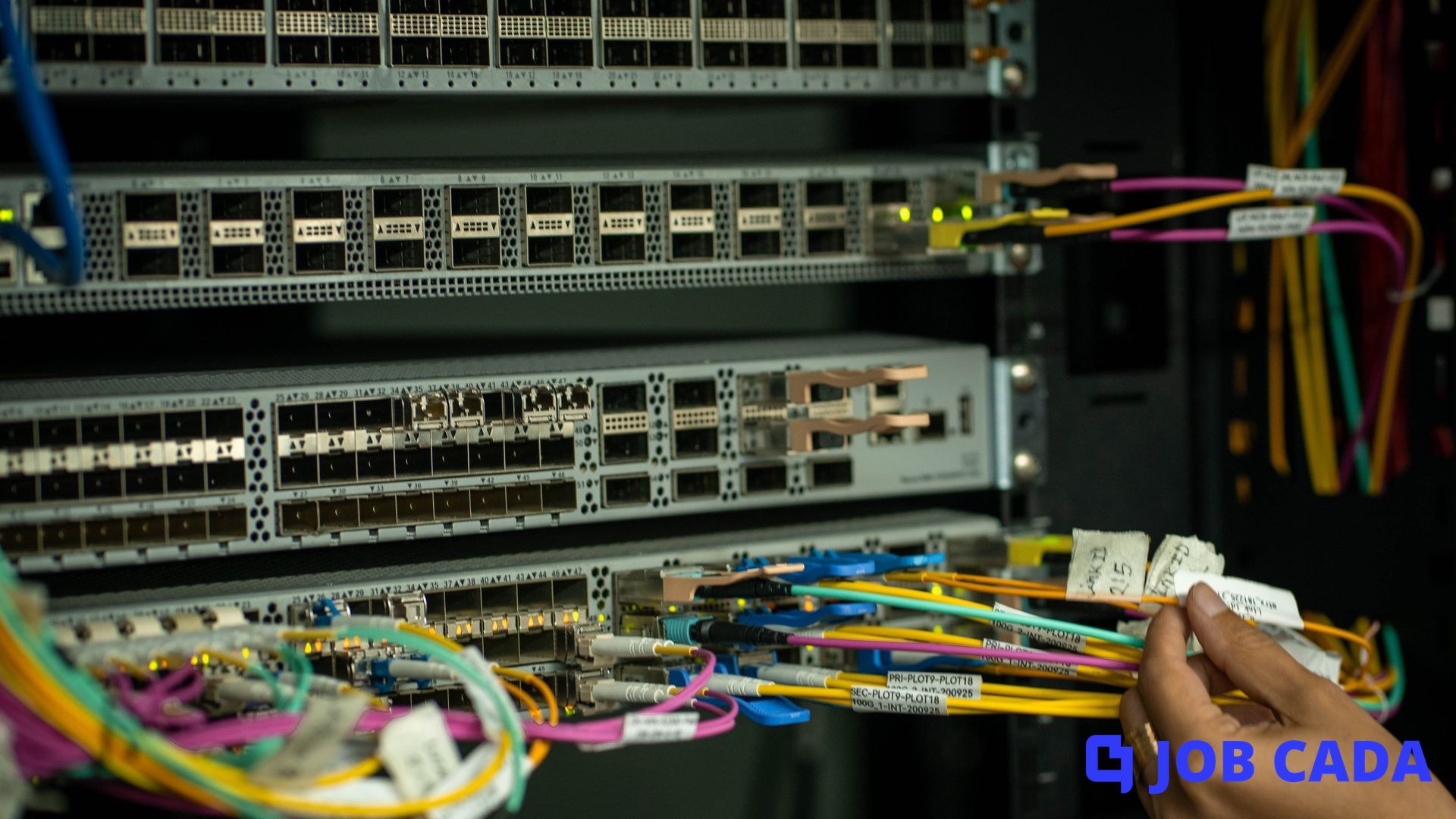
A data center technician keeps the computers inside a data center powered, connected, and running. On a normal shift you rack and unrack servers, replace failed drives, memory, power supplies and network cards, run and label copper and fiber cables, test connections, check error lights and logs, and close the ticket for every job you touch. You also decommission old equipment, receive deliveries, and document everything so the next shift can follow your work. The job is physical and shift-based. Expect to lift up to 40 or 50 pounds, spend long periods on your feet, work nights, weekends and holidays, and follow strict access control and change procedures. Hot aisles and cold aisles, protective equipment, and a ticket queue are the daily reality, not the exception.
There are two lanes inside the same job title, and picking the right one early saves you months. IT hardware technicians install and repair servers, network gear and cabling. Facilities technicians maintain the power and cooling systems: UPS units, generators, switchgear, chillers and air handlers. The IT lane is usually the faster way in for a beginner because the training is cheaper and faster. The facilities lane values trade experience directly, so it is the faster way in if you are already an electrician, HVAC technician or maintenance mechanic. For the full picture of every role in the building, including inventory, security and management, read our guide to what jobs are inside a data center.
Can You Get a Data Center Technician Job With No Experience?
Yes, but usually not by applying straight to a direct-hire posting at a large cloud company and hoping for the best. Those postings commonly ask for about a year of computer or server hardware troubleshooting or related IT experience. The beginners who get in use one of four routes that are built for people without that year: a paid trainee program, a contract role through a staffing firm, a smart hands job at a colocation site, or a year of help desk or desktop support first. All four count as real experience for the next application. Before you spend money on training, check that you can meet the basics nearly every posting lists.
| Requirement | What postings actually ask | How to meet it with no experience |
|---|---|---|
| Education | A high school diploma or equivalent, listed by Amazon and Microsoft as the minimum | No degree needed. A community college certificate helps but is not required |
| Experience | About one year of hardware troubleshooting or related IT experience in many direct-hire postings | Trainee program, contract role, smart hands job, or help desk work, see Step 5 |
| Background check | Expect one. Microsoft says employees must pass its cloud background check at hire and every two years after | Keep your record clean and be ready with ID and work history |
| Physical work | Amazon requires regularly lifting up to 40 pounds and joining group lifts above that. Google facilities postings say up to 50 pounds | Be honest about what you can lift. Warehouse or manual work already proves this |
| Shift availability | Days, nights, weekends and holidays, often on 12-hour shifts | Say clearly in your CV and interview that you can work nights and weekends |
| Transport | Some trainee programs require a valid driving licence and a reliable vehicle | Check the posting before you apply, and sort transport first |
| Work authorisation | Microsoft says it cannot sponsor work visas for these roles | Apply only where you already have the right to work |
If you tick every row except experience, you are closer than you think. Experience is the one requirement with four different workarounds, and the rest of this guide builds them in order.
Step 1: Pick Your Lane, IT Hardware or Facilities
“Data center technician” covers two different jobs, and the certification, the training and the entry point all change with your choice. Pick one lane now and stop splitting your study time between both.
| Lane | What you do | Best if you | First certification | Time to job-ready |
|---|---|---|---|---|
| IT hardware | Rack servers, replace parts, run and test cables, diagnose hardware faults, close tickets | You have no trade background and want the fastest, cheapest route in | CompTIA A+ | About 3 to 6 months of steady part-time study and practice |
| Facilities | Maintain UPS, generators, switchgear, chillers and air handlers, do preventive maintenance, respond to power and cooling alarms | You are an electrician, HVAC technician or maintenance mechanic, or you want a trade route | EPA Section 608 and OSHA 10 | Longer, because it needs trade training or an apprenticeship |
If you have no experience in either lane, pick IT hardware. The study material is free or cheap, the home lab costs almost nothing, and CompTIA A+ is the recognised first step. If you already work with electrical or HVAC systems, the facilities lane values that experience directly. A Google posting for a Data Center Facilities Technician, Electrical, accepts an associate degree, trade school certification or equivalent experience, plus about two years of industrial or commercial electrical work. Either lane leads to the same building. The mistake is trying to prepare for both at once and finishing neither.
Step 2: Build the Skills Hiring Managers Actually Test
Hiring managers care most about whether you can work safely, follow procedures, and fix hardware. Certificates help you get past the screen, but the interview and the first week on the job test your hands. Build these skills in the IT lane before you apply.
- PC and server hardware: identify and replace drives, memory, power supplies and network cards. Read error lights and logs. Know what a failed drive sounds and looks like.
- Networking basics: IP addressing, what a switch and a router do, copper versus fiber cabling, and how to clean and inspect a fiber connector.
- Linux basics: move around the command line and run simple diagnostic commands. Senior technician postings list Linux troubleshooting and light scripting, so even basic comfort helps.
- Ticketing and notes: every task is tracked in a ticket, and sloppy notes cause real problems on the next shift. Practise writing clear, short ticket updates.
- Cabling craft: terminate Ethernet cables, test them with a cheap cable tester, label both ends, and dress cables neatly with velcro ties. This is a large part of the working day, and neat cabling is visible proof of care.
Build a home lab that proves you can do the work
A certificate says you passed a test. A lab proves you can do the work, and data center hiring managers care about the second one more. You do not need expensive equipment. Start with a used server or an old desktop, which you can often find for very little money. One machine is enough to learn the core skills: installing RAM, swapping a hard drive, replacing a power supply, and setting up RAID. Install Linux on it, break things on purpose, then fix them and write down what you did. Add a networking lab with free tools. Cisco Packet Tracer lets you build virtual networks and practise switching, VLANs and IP addressing without buying hardware. Practise cabling on your home setup until your labelling is neat enough to photograph.
Keep a simple lab log. It becomes evidence on your CV and talking points in your interview. Here is a sample of what one week of a lab log looks like.
| Date | What I did | What I learned |
|---|---|---|
| Monday | Replaced the hard drive in an old desktop, installed Linux, set up a user account | Drive swap takes 15 minutes with the right screwdriver. Keep screws in a labelled tray |
| Wednesday | Terminated and tested 6 Ethernet cables, labelled both ends, dressed them with velcro ties | Two cables failed the tester on the first crimp. Re-terminating fixed both |
| Friday | Built a small network in Packet Tracer with two switches and a router, configured VLANs | A wrong subnet mask broke connectivity between VLANs. The ping test found it in seconds |
| Sunday | Simulated a failed server: removed the RAM, read the error lights, reseated it, documented the fix | Error lights point to the fault faster than guessing. Wrote the fix as a ticket update |
Four entries like that on your CV beat a full page of course names. If you want a broader starting point for entry-level IT work in general, our guide to how to get a job with no experience covers the same evidence-first approach for any first IT role.

Step 3: Get the Right Certification First
No single certification is required by law for IT data center work, but a few show up in postings again and again, and they prove you know the basics before an employer meets you. The order matters more than the count. Earn one, then the next. Do not study for two exams at the same time, and do not collect five certificates before applying for a single job.
| Order | Certification | Lane | What it proves | Suggested study time |
|---|---|---|---|---|
| 1 | CompTIA A+ | IT | Hardware, operating systems, troubleshooting, and safe working practice. The standard first IT certification | 6 to 8 weeks of steady study. Two exams, and Core 1 has up to 90 questions in 90 minutes. CompTIA recommends about 12 months of hands-on experience, but it is not required to sit the exam |
| 2 | CompTIA Network+ | IT | Cabling standards, IP addressing, switching, and network troubleshooting. Prepares you for network operations later | About 6 more weeks after A+. The exam has up to 90 questions in 90 minutes |
| 3 | CompTIA Server+ | IT | Server hardware, administration, security, and troubleshooting across on-premises and hybrid environments | A second-step certification, not a starting point. CompTIA recommends A+ plus two years in a server environment |
| 1 (facilities) | EPA Section 608 | Facilities | Required by the EPA for anyone who maintains, services, repairs or disposes of equipment that could release refrigerants | A short self-study course. Types I, II and III cover different equipment, and Universal covers all. It does not expire |
| 1 (facilities) | OSHA 10 | Both | Hazard awareness through OSHA’s Outreach Training Program. Common on construction-phase and facilities job sites | A 10-hour course. OSHA says the card is not a certification or licence |
| Later | CompTIA Security+ | IT | Security fundamentals. The baseline certification for many government and defence IT roles | Pick this third if you want the government and defence side of the work |
Start with CompTIA A+ plus hands-on practice. That combination is enough to get interviews for entry-level roles. Add Network+ or Server+ once you are working and can see which direction you want to go, and check whether your employer will pay for it. Microsoft, for example, says it pays for certifications its data center employees choose to pursue. For facilities work, NFPA 70E training covers electrical safety, protective equipment, risk assessment and energised work, and employers often provide it themselves. The CDCP, Certified Data Centre Professional, is a two-day EPI course covering data center basics such as power, cooling and layout. It is a paid instructor-led course, so weigh the cost before you book it. You can read the current A+ exam details on CompTIA’s A+ page before you commit to a study plan.
What to skip first: vendor-specific cloud certificates, advanced networking exams, and any data center credential that costs thousands before you hold a job. They help later, once you know which vendor your employer uses. A+ first, a lab log second, and an application third will get you further than a shelf of certificates with no practice behind them.
Step 4: Use Free and Low-Cost Training to Get In Faster
Several programs train people for data center work at little or no cost. Availability depends on where you live, so check the current details before you plan around one.
- Microsoft Datacenter Academy: Microsoft partners with community colleges and technical schools near its data centers. The first academy opened in 2018 at Southside Virginia Community College, and Microsoft says the program now has more than 30 partners and more than 12,500 students enrolled. Local partners run the classes and financial aid, and Microsoft offers scholarships and mentoring.
- Amazon trainee programs: Amazon runs paid Work Based Learning Program roles for Data Center Operations Technicians. A posting for Berwick, Pennsylvania described a 12-month training curriculum covering rack installs, hardware repair, network troubleshooting and safety certifications, with shifts that include nights and weekends. Amazon has also run paid AWS apprenticeships with a data center technician path aimed at people without prior technical experience, starting with veterans and military spouses.
- Google IT Support Certificate: a self-paced online course on Coursera. Google lists it at $49 a month in the US after a 7-day free trial, and says no experience is required and many learners finish in three to six months. It covers general IT support rather than data centers, but it builds the same hardware, networking and Linux basics.
- Community college programs: in Loudoun County, Virginia, Northern Virginia Community College offers a one-year, 26-credit Career Studies Certificate in Data Center Operations that prepares students for BICSI Installer 1 and 2 cabling credentials and OSHA 10, plus a two-year associate degree. Its ET Career Scholars program offers a free year for recent high school graduates. Check your local community college for similar programs near data center hubs.
- Military SkillBridge: service members within their last 180 days can apply for DoD SkillBridge fellowships. Equinix offers one in data center operations and critical facilities at sites including Ashburn, Dallas, Chicago, Atlanta and Seattle, with the service member still paid through the military.
If none of these programs runs near you, the home lab in Step 2 plus CompTIA A+ is the low-cost route that works everywhere. Do not pay thousands for a private training program before you have checked the free options above and the community college in your area.
Step 5: Choose the Entry Point That Fits Your Background
Most people do not walk straight into a full-time job at a big cloud company. These are the common first steps, and the right one depends on what you already have.
| Entry point | Who it suits | How to find it | Watch out for |
|---|---|---|---|
| Contract and staffing roles | Anyone with A+ and a lab log, including career changers | Staffing firms place technicians at large campuses for build-outs and ongoing work. Search for data center technician contract roles near data center hubs | Contract pay is often lower than direct-hire pay. A TEKsystems contract posting at Amazon’s New Carlisle, Indiana campus listed $23 to $24 an hour. The experience and site badge help you get hired directly later |
| Smart hands and remote hands at colocation sites | Beginners who can rack, cable and swap parts | Colocation companies rent space to many customers and employ technicians to do hands-on work for them, such as racking equipment, running cross-connects and swapping parts. Equinix describes this customer operations work, including fiber splicing and cage wiring | The work is customer-driven and varied, which is good experience, but the hours can be irregular |
| Help desk or desktop support | Anyone who needs the one year of experience that direct-hire postings ask for | Apply for help desk and desktop support roles, then move internally or apply to data centers after a year. A year of IT support covers the experience line in most technician postings | It adds a year to the plan, but it is the most reliable bridge, and it pays while you learn |
| Paid trainee programs | Beginners near a large operator’s site, and veterans | Amazon’s Work Based Learning Program and AWS apprenticeships, and Microsoft Datacenter Academy partner colleges | Places are limited and tied to specific sites. Apply early and check the site location before you commit |
| The trades | Electricians, HVAC technicians and maintenance mechanics | Apply straight to facilities technician roles. One Google entry facilities posting asks for a year of HVAC, electrical, controls, generator or mechanical experience | Do not apply to IT hardware roles with only trade experience and no A+ or lab work. Pick the lane that matches your background |
| Military experience | Service members and veterans | Electronics, communications, power generation and HVAC work in the military translate well, especially to facilities roles. Use SkillBridge in your last 180 days | Translate military job titles into civilian language on your CV, or recruiters will miss the match |
Apply to all of these at the same time, not one after another. A contract role that starts next month beats a direct-hire application that sits unanswered for three months. And apply to the contractor, not only the brand on the building. Cabling and facilities roles are often hired by the contractor doing the work, not by the operator whose name is on the site. Our guide to how to get an IT job explains the same apply-wide approach for IT roles in general, and the current openings on JobCada include technician and support roles across the US.
Step 6: Write a CV That Proves You Can Do the Work
Keep your CV to one page and match the words in the posting. Lead with a short skills list: hardware troubleshooting, cabling, Linux, ticketing systems, and any certifications with the date earned. For each past job, write what you fixed, installed or maintained, with numbers where you have them, such as how many devices you supported. Non-IT work counts if you frame it right. Warehouse work shows you can lift, follow safety rules and track inventory. Retail or restaurant work shows you can handle shifts and pressure. Say clearly that you can work nights, weekends and 12-hour shifts, because recruiters screen for it. For a full walkthrough of CV structure, read our guide to how to write a CV that gets shortlisted.
Here is a sample CV for a beginner with no IT job history. Use it as a template and replace every line with your own real experience.
“Alex Carter, Data Center Technician, alex.carter@example.com, (555) 014-7780. Skills: hardware troubleshooting, server racking, Ethernet and fiber cabling, Linux command line, ticketing systems, CompTIA A+ (earned March 2027). Home lab: built and maintain a home lab with one used server and two desktops. Replaced drives, memory and power supplies. Terminated and tested 40 Ethernet cables. Built a small network in Packet Tracer with two switches and a router. Experience: Warehouse Associate, 2025 to present. Picked and tracked 200 items a day with a scanner system, followed safety rules for lifting up to 50 pounds, and kept inventory records accurate across three shift rotations. Available for nights, weekends and 12-hour shifts.”
Now compare weak and strong CV bullets. The difference is proof: what you did, how many, and what changed.
| Weak bullet | Strong bullet | Why the strong one works |
|---|---|---|
| Responsible for computers at work | Replaced 40 laptop hard drives and 25 memory modules in six months, with zero repeat faults | Numbers, a time period, and a result |
| Good at networking | Terminated and tested 40 Ethernet cables in my home lab, labelled both ends, and documented the pinout for each run | Shows the exact skill, the volume, and the documentation habit |
| Helped customers with IT problems | Resolved 15 to 20 support tickets a week for staff, including password resets, printer faults and software installs, and wrote clear ticket notes for handover | Volume, the range of problems, and the handover habit, which data centers care about |
| Worked in a warehouse | Tracked 200 items a day with a scanner system and kept inventory records accurate across three shift rotations | Proves lifting, tracking and shift work, which map directly to inventory and asset work |
| Fast learner, hard worker | Earned CompTIA A+ in eight weeks of evening study while working full time, and built a home lab to practise every topic | A certificate with a time frame, plus the lab that proves the claim |
One page, no photo, no personal details beyond contact information, and no invented job titles. If you have no IT work history, your lab log and your non-IT jobs are your experience section. Write them the strong way and they count.

Step 7: Answer the Interview Questions They Always Ask
Data center technician interviews test three things: can you troubleshoot, can you follow a procedure, and will you actually show up for night shifts. Prepare short answers with a real example each. Here are the three questions that come up most, with a weak answer and a strong answer for each.
“Tell me about a time you fixed something that was broken.”
Weak answer: “I am good at fixing things and I learn fast.”
Strong answer: “In my home lab, a server would not boot after I replaced the memory. I checked the error lights first, reseated the memory, and it still failed. I swapped in a known-good module, the server booted, and I tested the old module in a second slot to confirm it was faulty. I wrote the fault and the fix in my lab log so I could repeat the steps. That is the process I would follow on a ticket: check the lights, isolate the part, test, and document.”
“What would you do if a server will not boot during your shift?”
Weak answer: “I would try everything until it worked.”
Strong answer: “I would check the error lights and the ticket history first, then work through the simplest causes in order: power, seating, and the last change made. I would not guess or swap parts at random. If the fault was outside what I was trained to do, I would escalate it with clear notes on what I had already checked, so the next person does not repeat my steps. And I would update the ticket before the shift ends.”
“Are you willing to work nights, weekends and holidays?”
Weak answer: “I suppose so, if I have to.”
Strong answer: “Yes. I know data centers run around the clock, and I am available for nights, weekends and 12-hour shifts. In my warehouse job I already worked three shift rotations, including nights, so I know what the schedule feels like and I can manage it.”
Notice what the strong answers share: a specific example, a clear order of steps, and a mention of documentation. That is the whole job in miniature. Practise each answer out loud twice before the interview. If you want more practice with the general format, our interview preparation guide covers the STAR method and the follow-up note, which apply here too.
How to Become a Data Center Technician With No Experience: Your 90-Day Plan
Here is the full route as a week-by-week plan. It assumes steady part-time study alongside a current job. Some people need longer, and that is fine. A working practice lab and one solid certification matter more than speed.
| Weeks | Focus | Done when |
|---|---|---|
| 1 to 2 | Pick your lane and check the requirements | You have chosen IT hardware or facilities, checked the postings near you, and confirmed you can meet the background check, lifting and shift requirements |
| 3 to 4 | Start CompTIA A+ study and set up your home lab | You have study material, an old desktop or used server, and a lab log started |
| 5 to 6 | Study A+ Core 1 and practise hardware swaps | You can replace a drive, memory and power supply without notes, and you have logged at least 5 lab tasks |
| 7 to 8 | Study A+ Core 2, add Linux basics and ticketing practice | You can move around the Linux command line, run diagnostic commands, and write a clear ticket update |
| 9 to 10 | Take the A+ exams, write your CV, practise cabling | A+ is earned or booked, your one-page CV uses the strong bullets from Step 6, and you can terminate and test a cable cleanly |
| 11 to 12 | Apply widely and prepare for interviews | You have applied to trainee programs, contract roles, smart hands jobs and help desk roles near data center hubs, set up job alerts, and practised the three interview answers in Step 7 |
After day 90, keep applying while you study Network+ if you chose the IT lane, or EPA Section 608 if you chose facilities. The first job is the hardest to get. The second one, with a year of data center experience behind you, is far easier.
What the First 90 Days on the Job Actually Look Like
No competitor guide covers this, and it is the part beginners worry about most. Here is what to expect once you are hired.
- Days 1 to 14: induction and shadowing. You learn the site layout, the access rules, the safety procedures, and the ticketing system. You shadow a senior technician and watch how they work a ticket from start to finish. Ask questions now, while asking is expected.
- Days 15 to 30: supervised tickets. You take simple tickets with a senior technician checking your work: drive swaps, cable runs, racking a server, receiving a delivery. Your ticket notes get reviewed. Neat notes and honest questions earn trust faster than speed.
- Days 31 to 60: your own ticket queue. You work a normal shift pattern, including your first nights and weekends. You learn the change control process, which means no work happens without an approved change record. You start to recognise the common faults on your site.
- Days 61 to 90: the probation review. Your manager checks your ticket quality, your attendance on shifts, and whether you follow procedures. Most technicians who pass probation are then trusted with solo rack installs and decommissioning work, and start building toward a senior technician role.
The first month feels slow because safety and procedure come first. That is normal. The technicians who struggle are usually the ones who skip documentation or guess at a fault instead of escalating. Do the boring parts well and the interesting work follows.
What Does a Data Center Technician Earn?
Pay varies by location, employer, shift premiums and experience, so treat every figure below as a benchmark, not a promise. The full pay table with every role is in our guide to what jobs are inside a data center.
| Benchmark | Figure | Source |
|---|---|---|
| Data center technician pay range | $60,000 to $90,000 a year | Built In, citing Glassdoor |
| Closest occupation, national median | $61,860 a year | US Bureau of Labor Statistics, May 2025 median for computer user support specialists, the closest occupation to a data center technician. Read the BLS page for computer support specialists for the full picture |
| Contract example | $23 to $24 an hour | A TEKsystems contract posting at Amazon’s New Carlisle, Indiana campus, reported by datacenterjob.net |
These are national figures for the closest occupations, not data-center-specific salaries, and a technician in Northern Virginia will usually earn more than one in a lower-cost market. Shift premiums for nights and weekends can add to the base. Check the posting for the site you are applying to before you judge an offer.
From Pakistan: What Is Realistic?
Most data center technician roles are onsite US roles, so a Pakistan-based reader should be honest about the routes. The realistic paths are remote NOC or monitoring work where it is offered, local ISP or telecom data rooms, or IT support first with data center skills added, then a move when a visa route opens. Do not pay any agent or training provider who promises a data center job abroad in exchange for a fee. The full Pakistan section, including the payment and platform notes, is in our guide to what jobs are inside a data center. If you are a student in Pakistan looking for online work while you study, our guide to online jobs in Pakistan for students lists real options that pay.
Your Application Checklist
- Lane picked: IT hardware or facilities, not both
- Requirements checked: diploma, background check, lifting, shifts, transport, work authorisation
- CompTIA A+ study started, with an exam date in mind, or EPA Section 608 and OSHA 10 for facilities
- Home lab built, with at least 10 logged tasks showing hardware, cabling and Linux practice
- One-page CV written with strong, numbered bullets and shift availability stated clearly
- Three interview answers practised out loud with a real example each
- Applications sent to trainee programs, contract and staffing firms, colocation smart hands roles, and help desk roles
- Job alerts set for data center technician, smart hands and contract roles near data center hubs
- Background check documents and ID ready, so a fast offer is not delayed
Key Takeaways
- How to become a data center technician with no experience starts with one lane, one certification, and one home lab, not with five certificates and no practice.
- Direct-hire postings often ask for about a year of experience, so enter through a trainee program, a contract role, a smart hands job, or a year of help desk work.
- CompTIA A+ is the first certification for the IT lane. Network+ and Server+ come after, once you are working.
- Your home lab log is your experience section. Ten logged tasks with numbers beat a page of course names.
- Say clearly that you can work nights, weekends and 12-hour shifts. Recruiters screen for it, and it is the easiest requirement to meet.
- Apply widely, including to contractors and colocation providers, not only to the big names on the building.
Frequently Asked Questions
Can I become a data center technician with no experience at all?
Yes, but usually through an entry point built for beginners: a paid trainee program, a contract role through a staffing firm, a smart hands job at a colocation site, or a year of help desk work first. Direct-hire postings at large cloud companies often ask for about a year of hardware troubleshooting or related IT experience, which those entry points provide.
Do I need a college degree to become a data center technician?
No. Amazon and Microsoft list a high school diploma or equivalent as the minimum for technician roles. A community college certificate or associate degree can help, especially in markets where colleges run data center programs, but it is not required. CompTIA A+ and hands-on practice matter more.
Is CompTIA A+ enough to get a data center technician job?
It helps you get past resume screens for entry-level roles, but employers also look for hands-on skill and shift availability. Pair A+ with practice on real hardware, a lab log you can talk about in the interview, and a clear statement that you can work nights and weekends.
How long does it take to become a data center technician with no experience?
With steady part-time study, most beginners can be job-ready in about 3 to 6 months: 6 to 8 weeks for CompTIA A+, plus home lab practice and a CV. A paid trainee program runs about 12 months while you are paid. Someone with IT support experience can often apply right away.
What is the easiest data center job to get with no experience?
Inventory and asset technician is the most accessible entry point, because it needs organisation and tracking skills more than a technical background. Physical security is also accessible where local licensing allows. For hands-on technical work, a smart hands role at a colocation site or a contract role through a staffing firm is the easiest way into the technician job itself.
Related Reading: What Jobs Are Inside a Data Center? Roles, Pay and How to Get In